Influence of moiré superlattice on electronic structure above the vacuum level in self-twisted antimonene heterostructures
Piotr Dróżdż, Mariusz Gołębiowski, and Ryszard Zdyb
We investigated the structural and electronic properties of twisted β-Sb/α-Sb heterostructures grown on a W(110) substrate. Structural characterization was performed in situ using low-energy electron microscopy and area-selected low-energy electron diffraction, allowing identification of the α-Sb and β-Sb phases and determination of the twist angle between allotrope sublayers. To probe the electronic properties, the intensity of backscattered electrons as a function of incident electron energy was analyzed, revealing pronounced variations between heterostructures differing only in twist angle. Possible scenarios explaining the origin of these changes are discussed. Consequently, the observed effects can be primarily attributed to moiré-related modifications of the electronic band structure induced by the twisted β-Sb layer. Additionally, masking of the local electronic features of individual mirror α-Sb domains within an isolated heterostructure was observed, likely due to charge transfer occurring both vertically (with the substrate acting as a charge reservoir) and laterally across boundaries between structurally mirrored α-Sb domains.
Interplay of Magnetic Proximity Effect and Epitaxial Strain in Transition Metal Monoxide Antiferromagnetic Heterostructures
M. Szpytm, E. Oleś, A. Kwiatkowski, P. Dróżdż, E. Gumieniczek-Chłopek, M. Ślęzak, T. Ślęzak, M. Zając, E. Partyka-Jankowska, and A. Kozioł-Rachwał
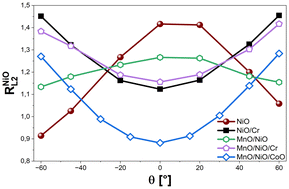
Controlling magnetic order in antiferromagnetic (AFM) materials is crucial for advancing spintronic technologies. Although epitaxial strain and magnetic proximity effects are known to independently influence AFM properties, their combined interplay in all-antiferromagnetic heterostructures remains largely underexplored. Here, we employ element-specific X-ray magnetic linear dichroism (XMLD) spectroscopy to investigate how epitaxial strain and interfacial exchange coupling cooperatively tune magnetic ordering temperatures and spin orientations in MnO/NiO/CoO heterostructures grown on MgO(001) substrates. We demonstrate that magnetic proximity effects dramatically enhance the Néel temperature of ultrathin MnO when grown on CoO and NiO, showcasing the significant impact of interfacial exchange coupling. Through systematic comparison of experimental and simulated angular-dependent XMLD measurements, we reveal that the NiO spin orientation is strongly governed by strain: the epitaxial tensile strain from MgO(001) stabilizes the out-of-plane alignment, while the compressive strain of the Cr buffer layers enforces the in-plane configuration. Remarkably, magnetic proximity to CoO overrides strain effects, imposing in-plane anisotropy within the NiO layer. In MnO/NiO bilayers, we observe bidirectional magnetic proximity effects, where out-of-plane-oriented NiO spins induce partial out-of-plane canting in MnO, while MnO simultaneously drives partial inplane rotation of NiO spins. Our results establish that rational design of all-AFM heterostructures enables systematic control of antiferromagnetic order through the interplay of epitaxial strain and magnetic proximity, providing a versatile route for engineering spin configurations in AFM-based spintronic devices.
Control of non-volatile magnetic properties of Fe/CoO grown on a piezoelectric substrate
W. Janus, M. Szpytma, E. Oleś, A. Kwiatkowski, P. Dróżdż, J. Kanak, M. Zając, M. Ślęzak, T. Ślęzak & A. Kozioł-Rachwał
In this study, we investigate the piezoelectric modulation of magnetic properties in an Fe/CoO bilayer grown on a Cr-buffered PMN-PT(001) substrate. An initial application of an electric field across the substrate has induced a non-volatile change in the coercive field of Fe/CoO. Subsequent voltage applications further modified the coercive field of Fe/CoO, maintaining the non-volatile effect below the blocking temperature of CoO. In contrast, no piezoelectric influence on the magnetic properties was observed in the Fe single layer grown on Cr/PMN-PT. X-ray magnetic linear dichroism measurements confirmed that the piezoelectric-driven modulation of magnetic behavior in Fe/CoO bilayer is primarily governed by changes in the magnetic state of the CoO film.
Freezing and unfreezing of antiferromagnetic spins in CoO(111) epitaxial films on a ferromagnetic support
A. Kwiatkowski, M. Szpytma, E. Świerkosz, E. Oleś, P. Dróżdż, A. Kozioł-Rachwał, M. Zając, E. Partyka-Jankowska, T. Ślęzak & M. Ślęzak
Epitaxial CoO(111)/Fe(110) bilayers grown on W(110) single crystal were studied using magneto-optic Kerr effect and X-ray magnetic linear dichroism techniques. A variety of possible configurations of frozen antiferromagnetic spins and in-plane easy axis of ferromagnet in CoO(111)/Fe(110) bilayers is presented. Our study shows that the blocking temperature, which marks the onset of exchange bias effect, strongly depends on the thickness of CoO layer. We confirmed that this dependence can be explained with the thermal stability of rotatable antiferromagnetic moments, that goes beyond classical finite-size effects. Partial unfreezing of antiferromagnetic spins at the vicinity of blocking temperature can be employed to reorient rotatable antiferromagnetic spins and refreeze them in a new orientation after subsequent cooling down the system.
On the Nature of Spin Reorientation Transition Thermal Hysteresis in NiO(111)/Fe(110) Bilayers
E. Świerkosz, A. Kwiatkowski, M. Szpytma, W. Janus, M. Zając, P. Dróżdż, E. Oleś, A. Kozioł-Rachwał, T. Ślęzak & M. Ślęzak
We report on temperature-driven in-plane 90° magnetization switching in NiO(111)/Fe(110) bilayer epitaxially grown on a W(110) single crystal, investigated using magneto-optical Kerr effect and X-ray magnetic circular and linear dichroism measurements. As the temperature varies, an abrupt switching of the easy axis between the in-plane Fe[001] and Fe[1-10] crystallographic directions is observed. In the temperature range of approximately 210–285 K, a thermal hysteresis region appears, where two energy minima coexist at a given temperature. Our experimental findings are supported by phenomenological modeling. Simulations incorporating temperature-dependent anisotropy constants successfully reproduce the key features of the observed phenomenon, most notably the temperature-driven hysteresis of ferromagnetic magnetization switching. The spin reorientation transition in both exchange-coupled ferromagnetic and antiferromagnetic layers is driven by the interplay between magnetocrystalline and interfacial magnetic anisotropies in the ferromagnet, which stabilizes specific magnetization orientation at given temperature.
Coexistence of α and β Antimonene Phases on a W(110) Substrate
Piotr Dróżdż, Mariusz Gołębiowski, Ryszard Zdyb
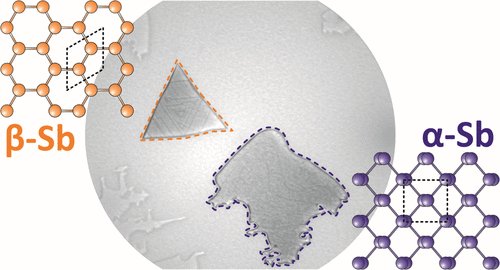
Antimonene (2D-Sb) nanostructures were synthesized on a W(110) substrate by using the molecular beam epitaxy method. By carefully controlling the W(110) substrate temperature during Sb deposition, isolated islands of the α-Sb and β-Sb antimonene allotropes were simultaneously formed on the surface. Antimonene growth was followed using low-energy electron microscopy (LEEM), revealing that α-Sb islands are a single-layer thick and formed by mirror domains with a fixed epitaxial relation to the W(110) substrate. In contrast, the β-Sb phase formed single-domain, multilayered nanostructures that were randomly rotated on the sample surface. Quantum size effect analysis of these two-dimensional (2D) nanostructures indicates notable differences in the electronic properties between the two systems. The coexistence of α-Sb and β-Sb phases suggests the potential for the formation of lateral (in-plane) heterostructures consisting of side-connected allotrope islands.
Observation of domain morphology in twisted antimonene layers via moiré superlattice contrast with low energy electron microscopy
Mariusz Gołębiowski, Piotr Dróżdż, Ryszard Zdyb
Using low energy electron microscopy we investigate the origin of the contrast between domains in a heterostructure composed of twisted two-dimensional antimonene layers. The contrast is observed in the bright-field microscopy mode under normal incidence of the electron beam. The heterostructure consists of a single-domain β phase grown on a top of two-domain α phase antimonene on a W(110) surface. We show that the observed contrast is due to the formation of two different moiré superlattices and it directly reflects the two-domain structure of α antimonene. We also demonstrate that the contrast depends on the relative symmetry and crystallography of two moiré patterns.
Ultrafast Laser-Induced Dynamics of Non-Equilibrium Electron Spill-Out in Nanoplasmonic Bilayers
Artur Avdizhiyan, Weronika Janus, Marcin Szpytma, Tomasz Ślezak, Marek Przybylski, Maciej Chrobak, Vladimir Roddatis, Andrzej Stupakiewicz, Ilya Razdolski
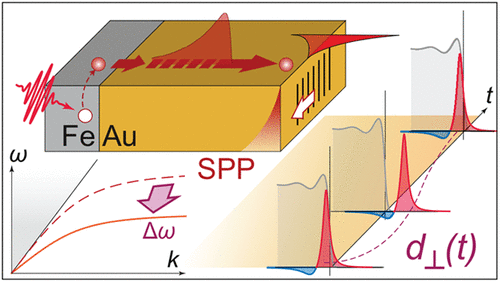
Contemporary quantum plasmonics capture subtle corrections to the properties of plasmonic nano-objects in equilibrium. Here, we demonstrate non-equilibrium spill-out redistribution of the electronic density at the ultrafast time scale. As revealed by time-resolved 2D spectroscopy of nanoplasmonic Fe/Au bilayers, an injection of the laser-excited non-thermal electrons induces transient electron spill-out thus changing the plasma frequency. The response of the local electronic density switches the electronic density behavior from spill-in to strong (an order of magnitude larger) spill-out at the femtosecond time scale. The superdiffusive transport of hot electrons and the lack of a direct laser heating indicate significantly non-thermal origin of the underlying physics. Our results demonstrate an ultrafast and non-thermal way to control surface plasmon dispersion through transient variations of the spatial electron distribution at the nanoscale. These findings expand quantum plasmonics into previously unexplored directions by introducing ultrashort time scales in the non-equilibrium electronic systems.
Transfer of Magnetic Anisotropy in Epitaxial Co/NiO/Fe Trilayers
M. Szpytma, M. Ślęzak, W. Janus, H. Nayyef, T. Ślęzak, A. Mandziak, M. Zając, D. Wilgocka-Ślęzak, T. O. Menteş, M. Jugovac, A. Locatelli & A. Kozioł-Rachwał
The magnetic properties of Co(10 Å)/NiO(40 Å)/Fe trilayer epitaxially grown on W(110) substrate were investigated with use of x-ray magnetic linear dichroism (XMLD) and x-ray magnetic circular dichroism (XMCD). We showed that magnetic anisotropy of Fe film that can be controlled by a thickness-driven spin reorientation transition is transferred via interfacial exchange coupling not only to NiO layer but further to ferromagnetic Co overlayer as well. Similarly, a temperature driven spin reorientation of Fe sublayer induces a reorientation of NiO spin orientation and simultaneous switching of the Co magnetization direction. Finally, by element specific XMCD and XMLD magnetic hysteresis loop measurements we proved that external magnetic field driven reorientation of Fe and Co magnetizations as well as NiO Néel vector are strictly correlated and magnetic anisotropy fields of Fe and Co sublayers are identical despite the different crystal structures.
From Magnetostatics to Topology: Antiferromagnetic Vortex States in NiO‐Fe Nanostructures
Michał Ślęzak, Tobias Wagner, Venkata Krishna Bharadwaj, Olena Gomonay, Anna Kozioł-Rachwał, Tevfik Onur Menteş, Andrea Locatelli, Marcin Zając, Dorota Wilgocka-Ślęzak, Piotr Dróżdż, Tomasz Ślęzak
Magnetic vortices are topological spin structures frequently found in ferromagnets, yet novel to antiferromagnets. By combining experiment and theory, it is demonstrated that in a nanostructured antiferromagnetic-ferromagnetic NiO(111)-Fe(110) bilayer, a magnetic vortex is naturally stabilized by magnetostatic interactions in the ferromagnet and is imprinted onto the adjacent antiferromagnet via interface exchange coupling. Micromagnetic simulations are used to construct a corresponding phase diagram of the stability of the imprinted antiferromagnetic vortex state. The in-depth analysis reveals that the interplay between interface exchange coupling and the antiferromagnet magnetic anisotropy plays a crucial role in locally reorienting the Néel vector out-of-plane in the prototypical in-plane antiferromagnet NiO and thereby stabilizing the vortices in the antiferromagnet.
Tunable magnetic anisotropy of antiferromagnetic NiO in (Fe)/NiO/MgO/Cr/MgO(001) epitaxial multilayers
W. Janus, T. Ślęzak, M. Ślęzak, M. Szpytma, P. Dróżdż, H. Nayyef, A. Mandziak, D. Wilgocka-Ślęzak, M. Zając, M. Jugovac, T. O. Menteş, A. Locatelli & A. Kozioł-Rachwał
We report on the magnetic properties of antiferromagnetic NiO(001) thin films in epitaxially grown NiO/MgO(dMgO)/Cr/MgO(001) system for different thicknesses of MgO, dMgO. Results of X-ray Magnetic Linear Dichroism show that together with an increase of dMgO, rotation of NiO spins from in-plane towards out-of-plane direction occurs. Furthermore, we investigated how the proximity of Fe modifies the magnetic state of NiO in Fe/NiO/MgO(dMgO)/Cr/MgO(001). We proved the existence of a multidomain state in NiO as a result of competition between the ferromagnet/antiferromagnet exchange coupling and strain exerted on the NiO by the MgO buffer layer.
Tunable Interplay between Exchange Coupling and Uniaxial Magnetic Anisotropy in Epitaxial CoO/Au/Fe Trilayers
H. Nayyef, E. Świerkosz, W. Janus, A. Klimeczek, M. Szpytma, M. Zając, P. Dróżdż, A. Kozioł-Rachwał, T. Ślęzak & M. Ślęzak
We show that the interaction between ferromagnetic Fe(110) and antiferromagnetic CoO(111) sublayers can be mediated and precisely tuned by a nonmagnetic Au spacer. Our results prove that the thickness of the Fe and Au layers can be chosen to modify the effective anisotropy of the Fe layer and the strength of the exchange bias interaction between Fe and CoO sublayers. Well-defined and tailorable magnetic anisotropy of the ferromagnet above Néel temperature of the antiferromagnet is a determining factor that governs exchange bias and interfacial CoO spins orientation at low temperatures. In particular, depending on the room temperature magnetic state of Fe, the low-temperature exchange bias in a zero-field cooled system can be turned “off” or “on”. The other way around, we show that exchange bias can be the dominating magnetic anisotropy source for the ferromagnet and it is feasible to induce a 90-degree rotation of the easy axis as compared to the initial, exchange bias-free easy axis orientation.
Memory of Frozen and Rotatable Antiferromagnetic Spins in Epitaxial CoO(1 1 1)/Fe and NiO(1 1 1)/Fe Bilayers
M. Ślęzak, H. Nayyef, P. Dróżdż, W. Janus, E. Świerkosz, M. Szpytma, M. Zając, A. Kozioł-Rachwał, T. Ślęzak
We combined X-ray magnetic linear and circular dichroism together with magnetooptic Kerr effect measurements in order to follow the magnetic properties of epitaxial CoO(1 1 1)/Fe(1 1 0) and NiO(1 1 1)/Fe(1 1 0) bilayers. We find that in both studied cases ferromagnetic sublayer plays a dominant role and determines the magnetic state of the neighboring antiferromagnet, however different interaction scenarios are observed. In CoO/Fe bilayers the antiferromagnetic spins are frozen and their orientation is imprinted by magnetization of Fe layer as the system passes the Néel temperature of CoO. For NiO/Fe bilayers, the antiferromagnetic spins are rotatable and always follow the reorientation of Fe magnetization that can be controlled by external magnetic field or via the temperature and thickness driven spin reorientation transition in Fe(1 1 0).